



Designing an AI-powered B2B SaaS recruitment platform that processed 1,000+ applicants and secured a $155K Seed round by balancing high-volume automation with human accountability
Quick Overview
Reduced screening overload with AI-assisted evaluation while maintaining recruiter control.


The ecosystem: Recruiter Dashboard + AI Interview Interface + Candidate Evaluation Report.
Market Insight & Product Strategy
[01 Context]
Built in a bootstrapped startup, the goal was to validate the market quickly through live pilots and deliver a production-ready solution.
[02 Market Reality ]
Recruitment wasn’t broken by lack of AI - it was broken by lack of trust.
Recruiters were overwhelmed (1000+ applications) but resisted black-box automation that removed decision control.
[03 Strategy]
Proof-Based Automation
Surfacing AI insights with high transparency to maintain recruiter accountability.
Extreme Scalability
Designing for the high-volume reality of modern SaaS and recruitment workflows.
core Problem
The Funnel is Choked
High volume broke trust, not just workflows.
[01 Insight]
Automation increased speed but reduced transparency, creating a “black-box” experience.
[02 Pain Points]
[03 Strategic Objective]
Enable high-volume screening without sacrificing trust or human accountability.
DESIGN STRATEGY
Execution Strategy Under Constraints
Shipped fast by prioritising validation over process perfection.
Discovery & Research Strategy
Decision:
Shifted from upfront research to continuous real-world validation
Execution:
Used founder insights to skip long discovery
Tested directly in live hiring environments
Impact:
Directly reduced recruiter fatigue by validating features in real hiring conditions
Fast Validation
High-Fidelity First
Accelerating Handoff Integrity
Decision:
Replaced wireframes with high-fidelity prototypes as the primary communication layer
Execution:
High-fidelity prototypes as a single source of truth
Early engineering collaboration
Impact:
Eliminated alignment gaps and reduced production errors before development
Engineer Collaboration
SYSTEM ARCHITECTURE
The Product Backbone: End-to-End Hiring Flow
Instead of building features, we designed a single continuous hiring system.
The Intake
Standardising job requirements and centralising the raw applicant pipeline.
Job Creation
Create structured job requirements using Al and templates.
Candidate Intake
Central hub to aggregate and manage all candidates.
AI Resume Screening
Filters candidates using Al-based evaluation.
Asynchronous Interviews
Conducts async, language-aware candidate assessments.
Multi-Signal Scoring
Combines resume, communication, and technical signals into a unified score.
Recruiter Overrides
Empowers recruiters to manually adjust or bypass Al recommendations.
Reporting & Analytics
Generates high-level summaries and insights on hiring funnel health.
Features & UX decisions
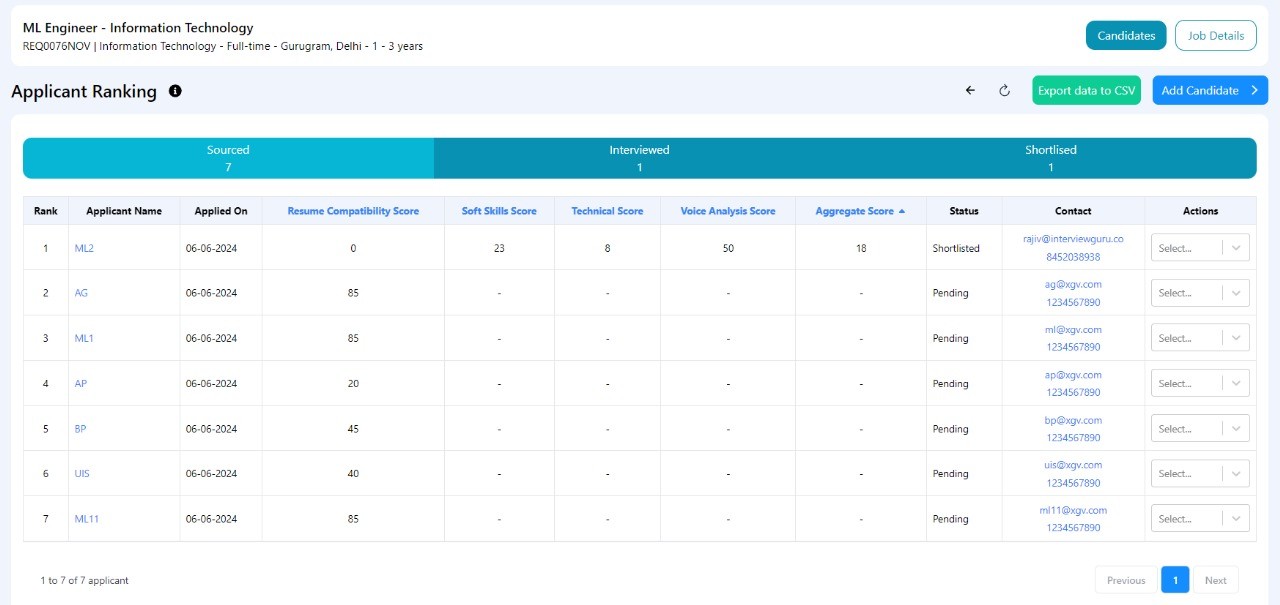
Candidate Prioritisation at Scale
Problem
Recruiters struggled to scan large candidate volumes efficiently.
Impact
Successfully triaged a raw pool of 1,000+ applicants, confidently surfacing 300 high-quality shortlists without recruiter burnout.

Candidates are sorted by aggregate score to reduce cognitive load while allowing human override.
AI screening with human control
Problem
Recruiters were hesitant to trust AI-generated recommendations blindly.
Decisions
Keep AI recommendations assistive, not authoritative:
Supporting Decisions
AI insights are visible but non-binding
Interview playback, score breakdown, and confidence indicators available
Recruiter makes final call
Impact
95% recruiter satisfaction, 'assistive, not authoritative' UX bridged the AI trust gap.
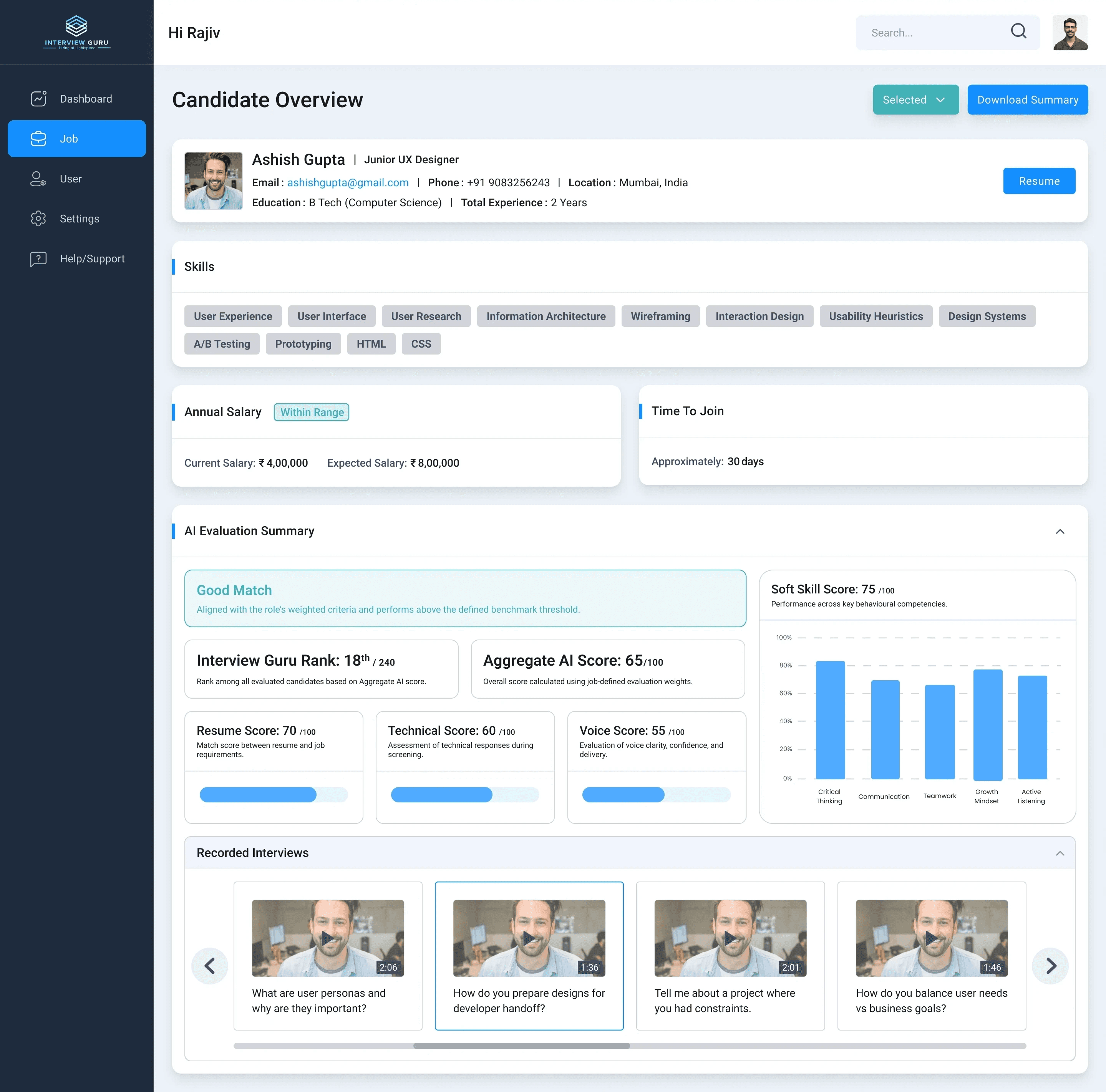
AI insights support decision-making without removing recruiter accountability.
Eliminating the Hiring Cold Start
Problem
Recruiters were losing hours to drafting repetitive job posts and dealing with formatting inconsistencies across roles.
Decisions
Introduced a multi-modal job creation flow that eliminates the need to start from a blank slate.
Supporting Decisions
AI-assisted JD generation to quickly structure role requirements
PDF-to-JD extraction to convert existing documents into structured inputs
Reusable templates for recurring hiring needs
Duplicate job functionality to eliminate repetitive setup
Impact
Enabled 7 early-adopter B2B clients to seamlessly launch 50+ standardised job campaigns, eliminating manual data entry from the cold-start process.


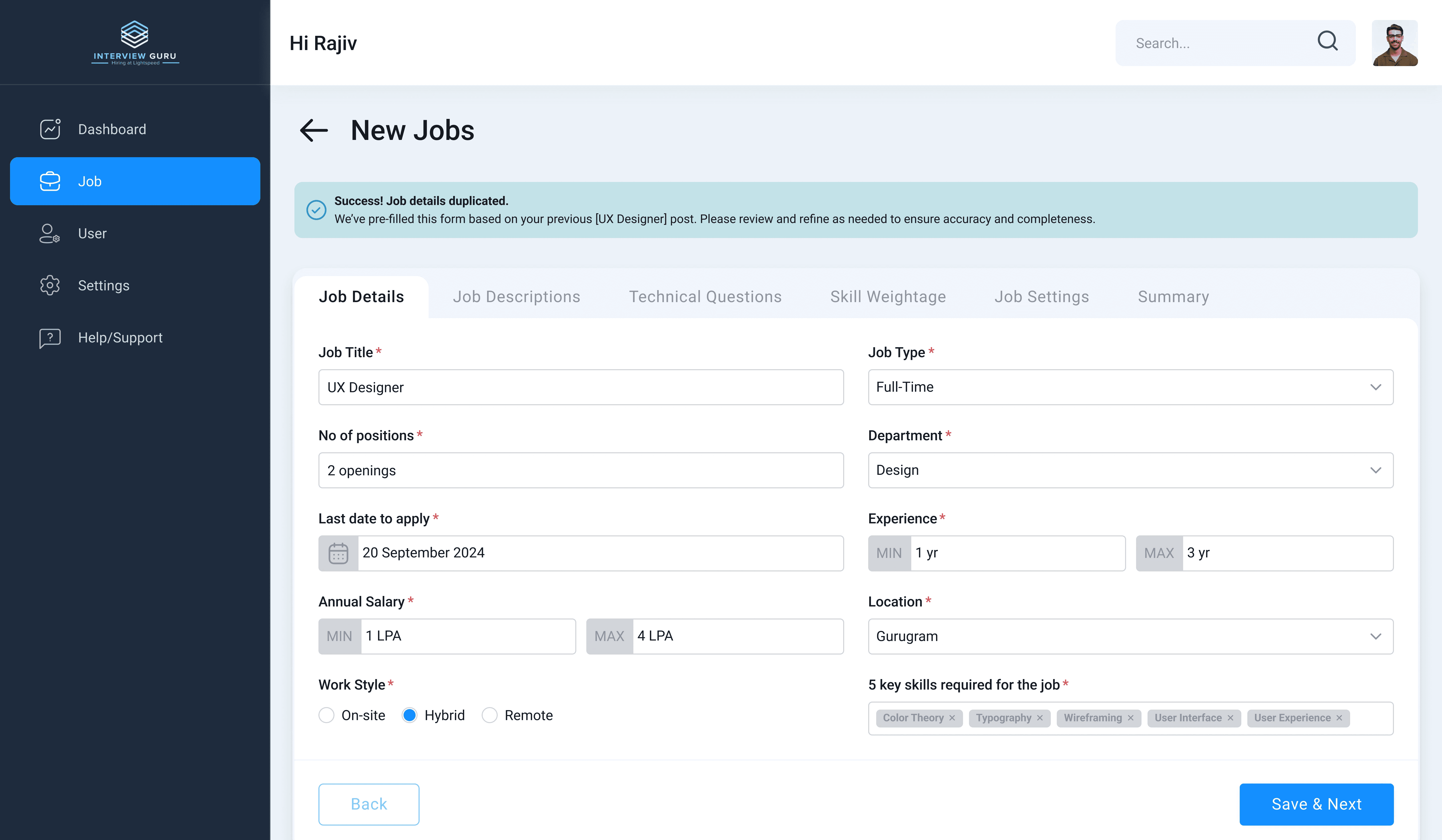

From blank page to structured job in seconds - recruiters can start with templates, generate roles using AI, or reuse existing jobs, eliminating repetitive setup and accelerating hiring workflows.
Designing for Scale
Problem
Manual workflows and organic applications fail to meet high-volume candidate sourcing needs.
Decisions
Enabled controlled bulk operations while maintaining the recruiter in charge of critical actions.
Supporting Decisions
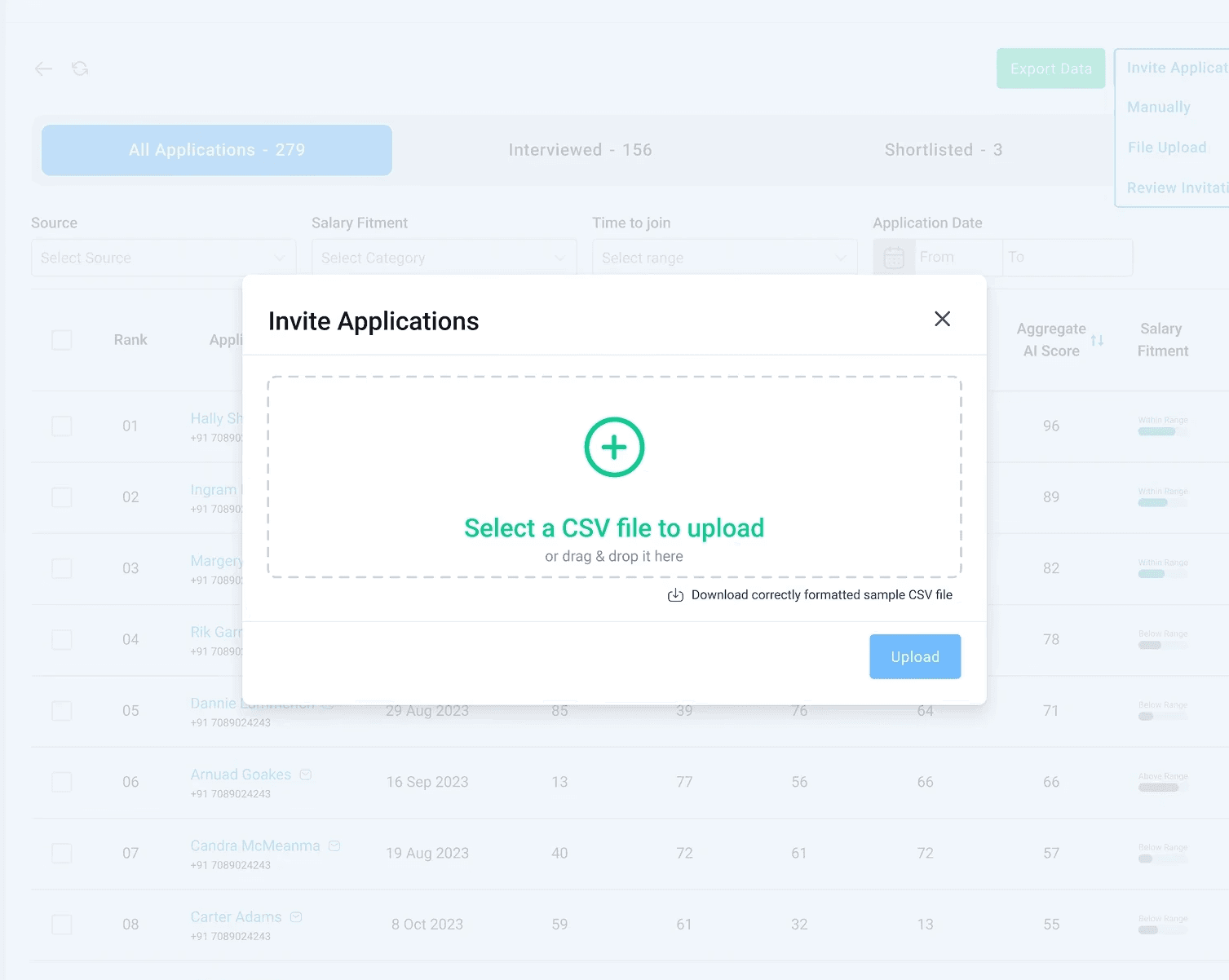
Bulk CSV upload for fast candidate ingestion
Bulk invite & status updates with confirmation modal
Recruiter-triggered invites (not automated)
Manual candidate addition for edge cases
Impact
Streamlined manual processes with bulk actions, allowing recruiters to manage 750+ candidates' invites/updates with zero errors.


Bulk actions reduced repetitive work and enabled recruiters to operate efficiently at scale.
Hiring Performance Dashboard
Problem
Leadership lacked a unified view of hiring performance. Data existed, but there was no structured way to quickly assess hiring momentum, ageing roles, or sourcing distribution.
Decisions
Positioned the dashboard as a decision-support reporting layer, not an operational tool.
Supporting Decisions
Snapshot metrics (volume + trend indicators)
Trend visualisation (applications vs interviews over time)
Diagnostic insights (ageing roles, source distribution)
Department filters
Time-based filtering
Impact
Transformed static reports into a real-time executive dashboard, eliminating manual data compilation for leadership.
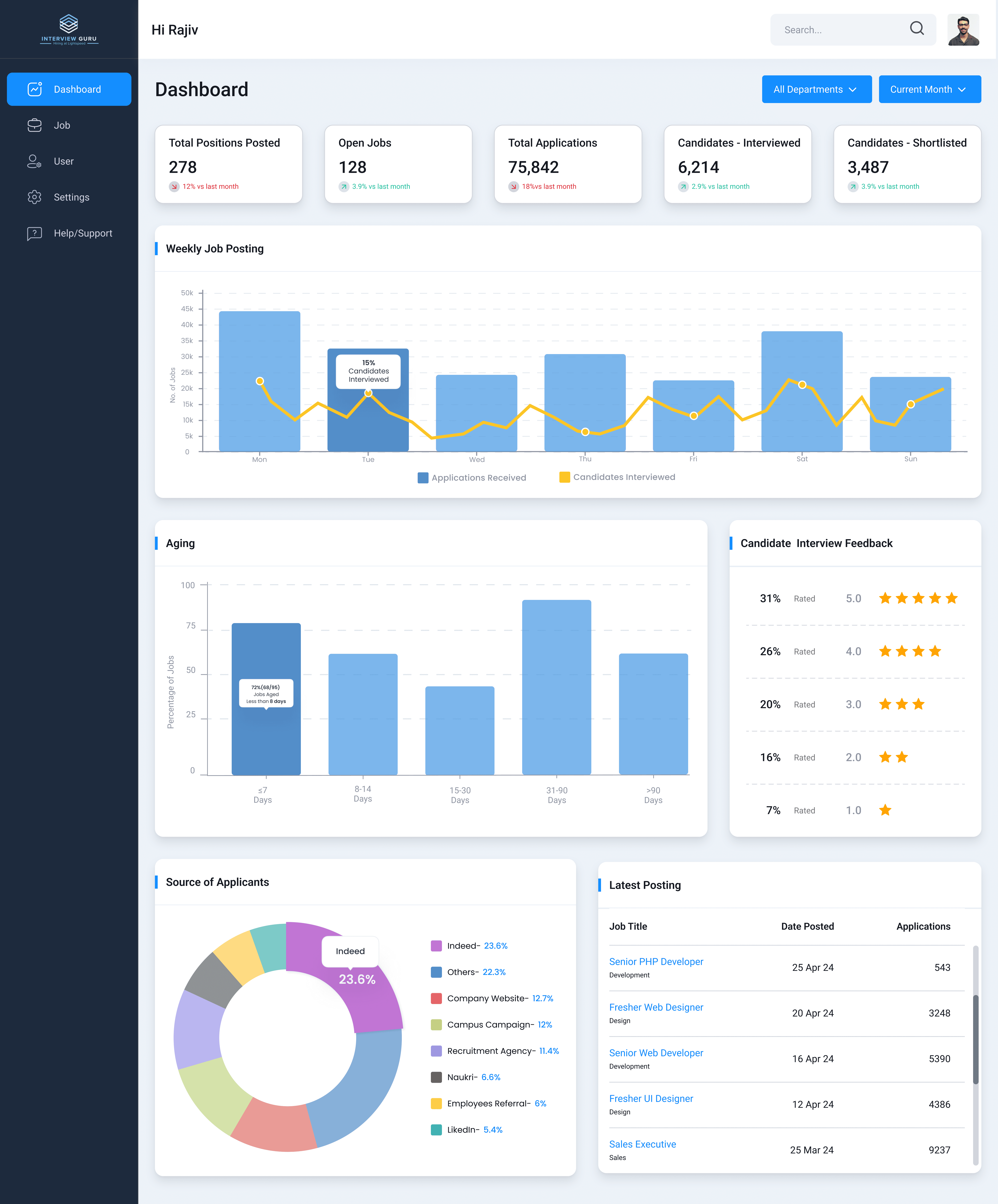
Multi-layered reporting that balances high-level executive snapshots with granular diagnostic trends.
Humanising the AI Interview Experience


A staged interview flow designed to reduce technical uncertainty and maximize data capture without causing anxiety.
UI Foundations & Components
Preventing Visual Drift
Under intense demo pressure, a formal design system was a luxury. Instead, I established a lightweight, implicit component system to maintain velocity without sacrificing clarity.

A scalable, lightweight system balancing visual clarity with rapid, consistent delivery across complex data views.
DEVeloper HANDOFF
Design-to-Development Alignment
Bridged the gap between design intent and production by resolving layout instability under real technical constraints.
Broken Layout

Fixed UI
Impact
Delivered a production-stable interface that scales reliably across screen sizes without visual drift or usability issues.
Outcome
Impact & Business Value
Validated that AI in hiring only works when the UX builds trust - driving adoption, efficiency, and measurable business growth.
Seed Round Secured
Platform's intuitive design and strong pilot adoption rates demonstrated market readiness.
Recruiter Satisfaction
Overcame 'black-box' scepticism via transparent scoring and manual overrides.
Interview Completion Rate
High throughput (750/1,000) proved that the human-centric UI successfully mitigated AI anxiety.
B2B Pilot Clients
Launched 50+ job campaigns with near-zero support overhead.
Applicants Triaged
Improved the recruitment workflow, prioritizing the top 30% of applicants.
REFLECTIONS
From Execution to System Thinking
Building under constraints required trade-offs. Looking back, these are the shifts I would make to scale the system more intentionally.
Traceable AI Decisions
Move from opaque scoring to explainable outputs by linking scores directly to candidate evidence.
Makes AI decisions auditable and trustworthy
Ai
Faster Recruiter Actions
Replace multi-step dropdowns with direct manipulation (drag-and-drop pipeline).
Reduces friction in high-volume workflows
Workflow
Earlier Edge-Case Testing
Test real hiring scenarios earlier instead of ideal flows.
Prevents breakdowns under real-world complexity
Validation
System Thinking from the Start
Introduce lightweight design systems earlier to avoid UI drift.
Improves consistency without slowing execution